
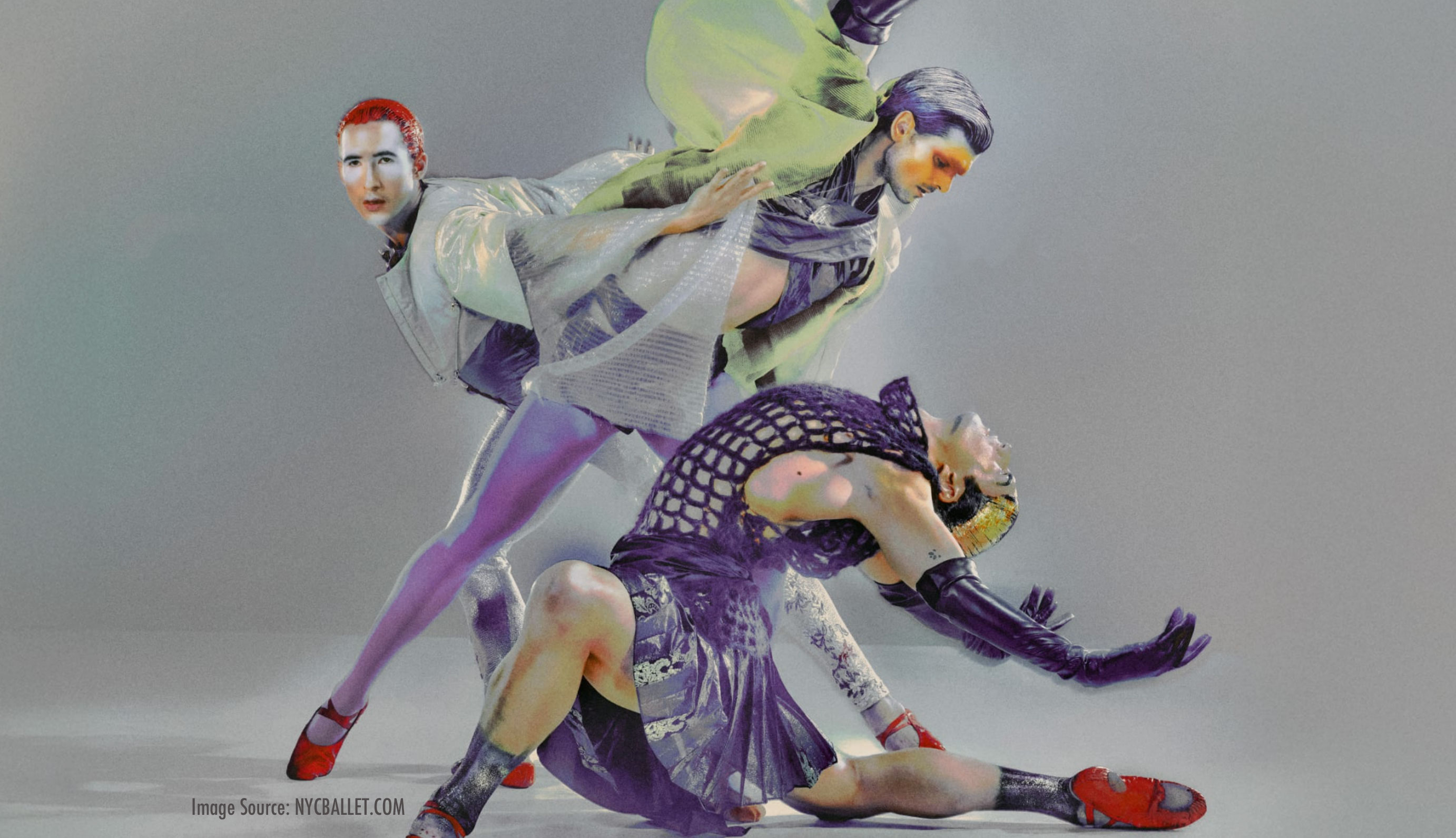
NYC Ballet is an incredible organization. It took years to get off the ground and cement its place as a cultural institution but today it’s the largest dance company in the United States with 90 dancers and 150 dances in its repertory. It was the highlight of a dreary cold NY February to see a working rehearsal of the company in its landmark David Koch Theatre located at the Lincoln Center. I felt depressed and down and didn’t think I would go but I’m so glad I made it because this is what I saw when I walked in:

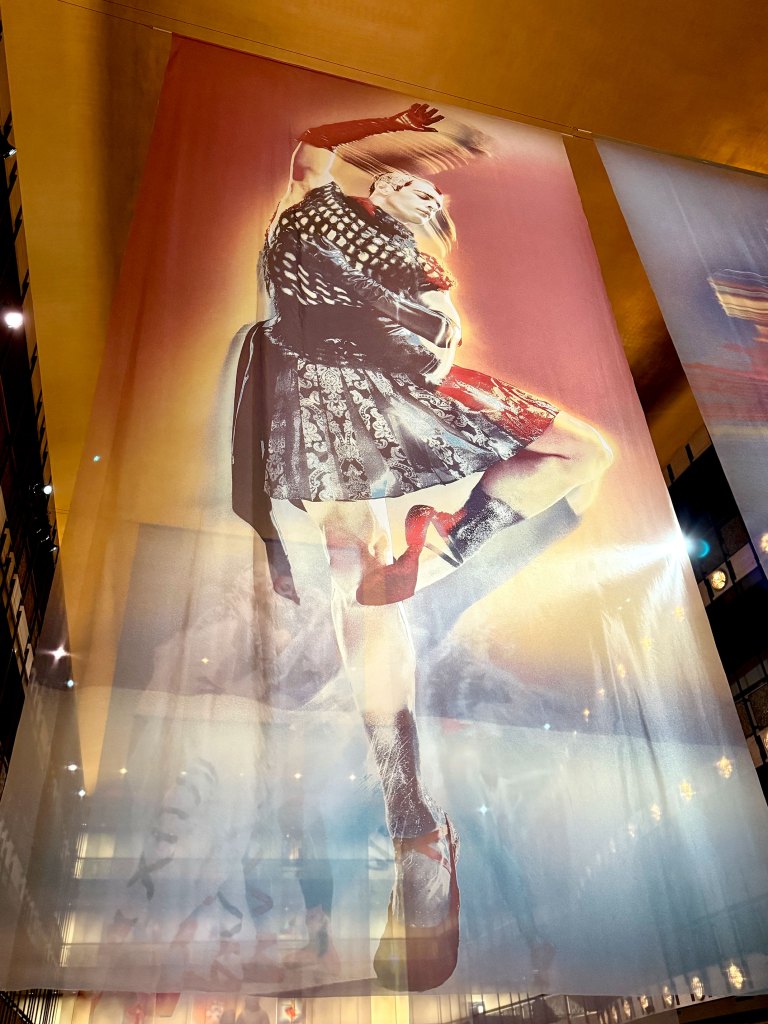
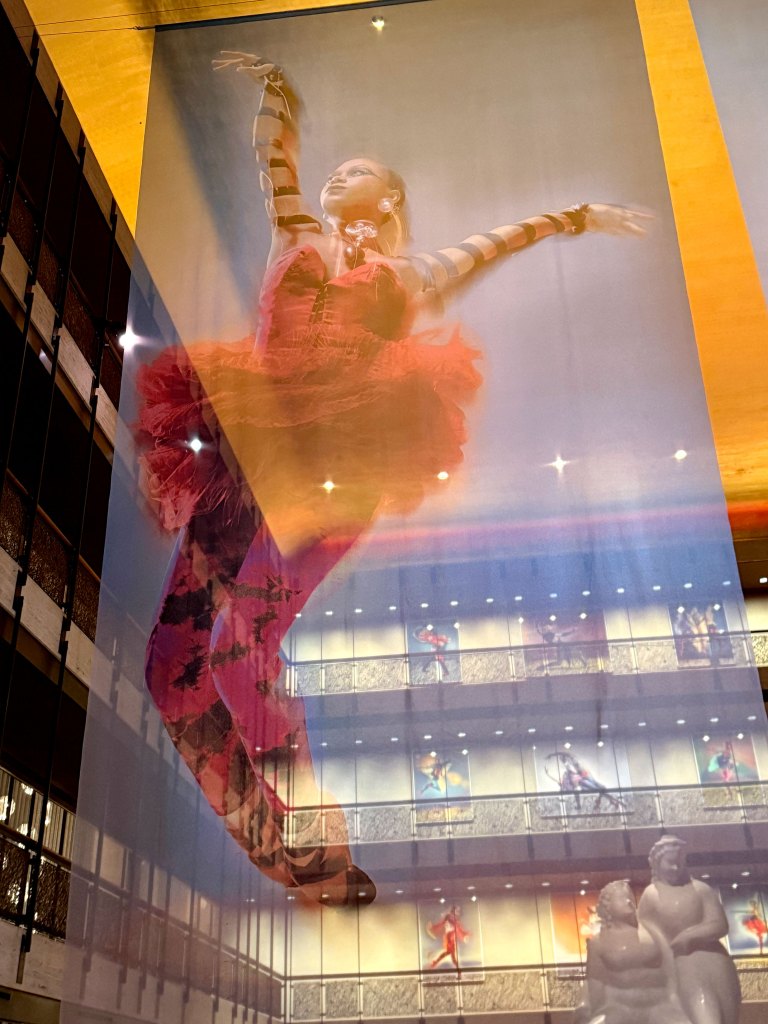
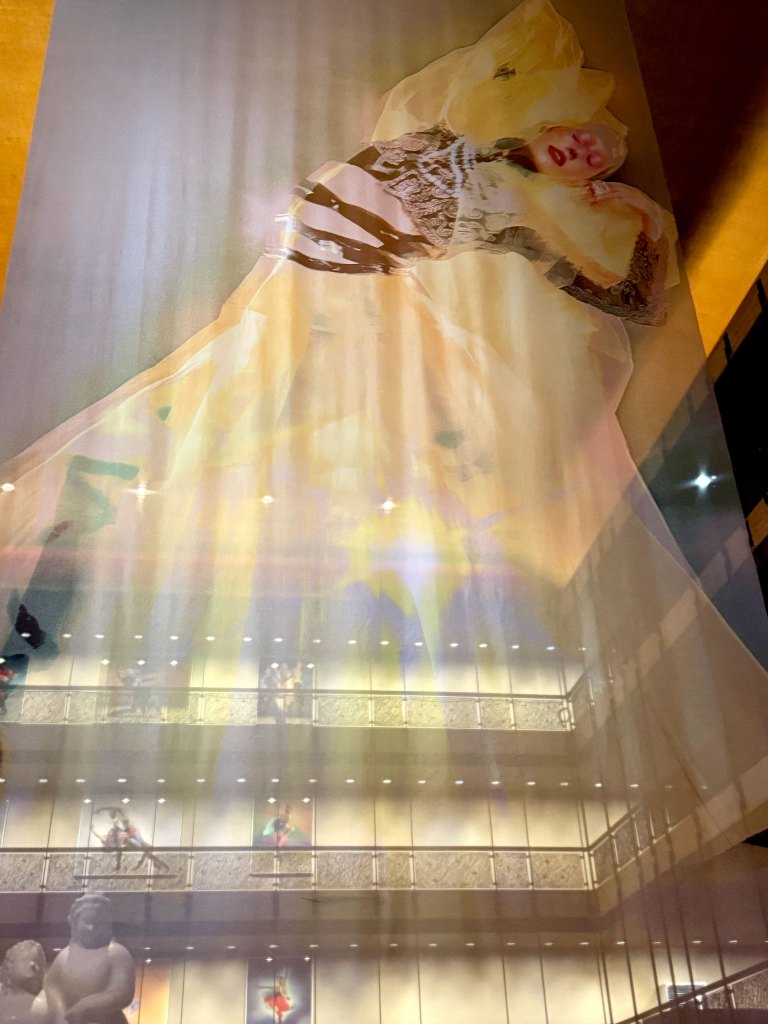


As my mouth dropped, my eyes traveled upwards to take in colossal, see-through screens with pictures of dancers taken by Elizaveta Porodina. I was transfixed. These images are so breathtaking, words cannot describe the experience. It truly brings this art form into the 21 Century. Never has ballet looked so contemporary and cutting edge. Illuminated by an incredible artist who worked with countless celebrities, it makes ballet as relevant today as it was 3 centuries ago.
The David Koch Ballet Theatre is amazing for many reasons. Not only is this the first theatre in the US designed specifically for ballet, it’s a gorgeous space filled with works of art, sculptures, and incredibly beautiful lighting. Designed by Phillip Johnson, completed in 1964, the theatre is a work of art in itself.
Now this landmark is open to the public for FREE. Walk in between 10 am and 6 pm, and a volunteer will escort you around the space, where you can see works by the most famous artists in the world, including Keith Haring, Santiago Calatrava and many others. The promenade level is dominated on both side by 50 foot sculptures created by the artist Elie Nadelman, called Circus Women and Two Nudes, they were carved out of a single piece of carrera marble and are so big, they were placed here before the exterior wall of the building. One could say the building was created around these gigantic sculptures. And now, hanging between these marble giants are gorgeous, absolutely mesmerizing photos of NYC Ballet dancers by Elizaveta Porodina. Check out her insta page for more inspiration: @ElizavetaPorodina.
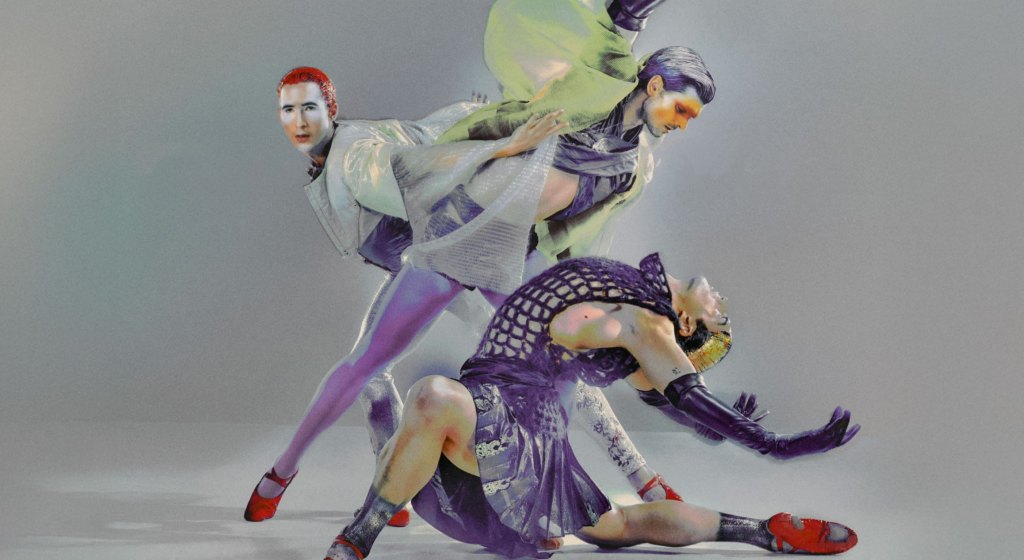
I was under the spell of these art works and completely forgot, I actually came to see a ballet rehearsal!!! Making my way into the 1st ring, I took a seat and looked at the blank stage. It was a rehearsal for a piece that’s not well-known. If fact, taking apart the music, the costumes and the choreography, it was really quite bizarre. The music, if those sounds could indeed be called music, is akin to a creaking door. In fact, the piece is called Variations for a Door and a Sigh composed by Pierre Henry.
If you listen to the music and close your eyes, it’s easy to imagine this is what space sounds like, strange bouncing sounds leaping away and coming back at you.
The choreography doesn’t clear anything up. Unlike full length ballets that have a story line and the dance moves evolve around telling that story and building up the characters, like the Swan in Swan Lake or the princess in Sleeping Beauty, there’s no story here. There’re only two dancers – pas de dues – dance for two. But they don’t really dance together as much as they bounce off each other, the choreography was as strange as the music. At times, it seemed they were dancing alone while inhabiting the same stage. The ballerina is the Door while her male companion is the Sigh.
The most interesting thing about the performance were the costumes, while his was a sleek leotard, she was connected to a huge billowing piece of black fabric, akin to a tent. It covered the entire stage. At times, the corners of the fabric were pulled up from the top of the stage by wires, creating an effect of a floating ship.
The light reflecting off the enormous folds of the fabric made the effect hypnotic. It was hard to look away. From a sea of billowing fabric emerges the ballerina, like a butterfly, fluttering around, flapping her giant wings. Then she disappears again, covered by the folds of the undulating fabric and the effect is truly memorable. A week later, I still l can’t get the images out of my head.
The lighting sealed the deal. The body of the ballerina was lit up to reflect off the back screen, creating an optical illusion of a huge ballerina dancing behind the screen. It was like a black and white movie on a huge scale. The shapes her body created on stage and on screen seemed surreal. It felt like watching a magic show, you see the magic in front of you, but you don’t understand how it’s possible.
Taken apart, none of it makes any sense. The music is not melodic, the choreography is not harmonious, the costumes are not classical ballet tutus and the lighting is monochromatic black and white. But bringing all these elements together created an unforgettable masterpiece. To me, the sign of a real work of art, is that it elevates our consciousness above the daily worries, and imprints on our subconsciousness. It creates imagery so impactful, it stays with us forever. As I go through the daily grind, I find myself daydreaming back to the performance.

_______
The history of ballet starts in Italy in the 16th century, the word ballet coming from Latin root “Ballo” to dance. It was a form of live entertainment for the royal court long before there was tv, radio or even electricity. Like many cultural endeavors, the ballet was brought to the rest of Europe by the infamous Medici family, wealthy, educated and notoriously ambitious. Catherine de Medici married the French Dauphin (Prince) and the French court adopted the ballet as an elegant and beautiful art form. Louis XIV, the kind of France was a ballet aficionado and starred in his ballets as a principal dancer. The fashion of the time called for men tights and ballet was a perfect medium to show off the monarch’s shapely calves.
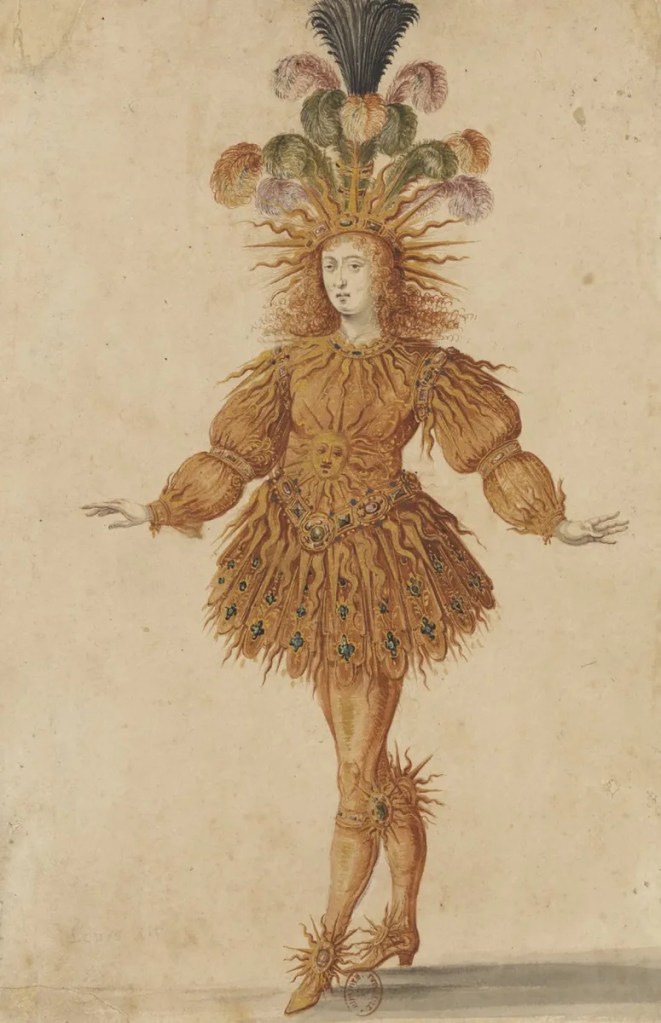
Louis XIV was so taken with ballet, he not only wanted to be a ballerino but he established the first school of ballet in 1661 Academie Royal De Danse, where many ballet steps were defined, hence the French names prevalent in ballet lexicon.
The French King also created a ballet called Ballet Royal de la Nuit – Royal Ballet of the Night, which lasted 12 hours, it entertained his royal court from night fall to sun rise. Talk about partying all night. No modern audience could withstand such demands on our time, where our attention spans are down to minutes and seconds, 12 hour performance seems insane. Another thing that might be hard for us to believe is that Luis XIV used his performance as a PR campaign to demonstrate his strength and power. When we think of powerful monarchs, dancing en point (on tippy toes) doesn’t spring to mind but this was actually very successful in cementing Louis XIV’s power as the sole ruler of France, putting down the initial embers of a revolution and having France ruled by the monarchy for another century, before his grandson, Luis XVI and his wife Marie Antoinette had their heads chopped off by the revolutionaries in 1793.
After the ballet became a popular form of entertainment in the French courts, it traveled to other royal houses as most rulers tried to emulate the opulence, extravagance and over the top luxury of the French court. Just remember the palace of Versailles built by our ballet King Louis XIV, its 700,000 feet of golden gilded palace, emaculately planted gardens, dozens of fountains on a scale impossible to describe:

The Palace of Versailles c. 1668 by Pierre Patel
There’s an entire room at the Met dedicated to a drawing of Versailles that was done by an American painter John Vanderlyn to capture the scale of this tremendous place. The panoramic view wraps around hte room and there’re benches in the middle. Sitting here for a few minutes can give a taste of what it was like to be at Versailles and to walk its grounds.
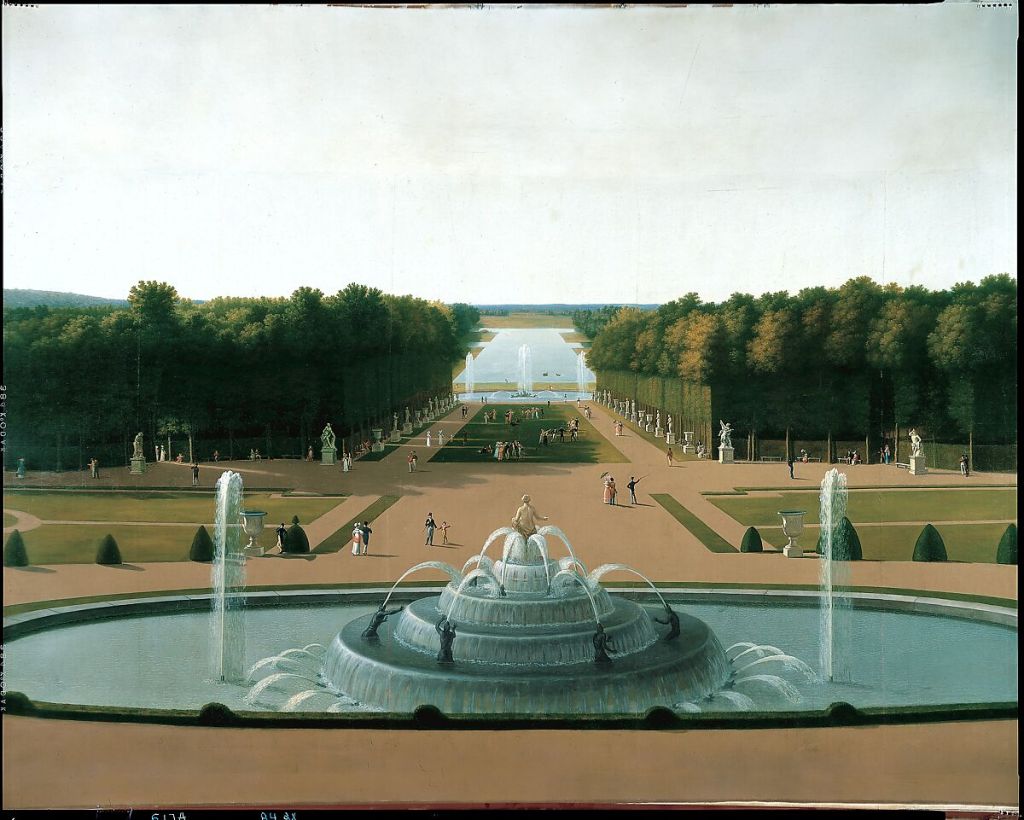
Naturally, all the other European monarchies looked to the French Royal court and tried to keep up by building ginormous palaces and throwing all night parties. The Russian empress Catherine the Great commissioned her summer residence, the Peterhof Palace, based on the blueprint of Versailles and on a scale just as grand. It’s only natural that they would bring the royal dance form, called ballet, to the Russian Court and establish their own academy to train dancers.

Fast forward to the 20th Century. Time of great upheavals, social change, industrialization. Sergei Dyagilev, a Russian impresario, took the Russian Ballets from the Royal Russian stages to Paris, where it captivated audiences. He brought this beautiful art form out of the royal palaces onto theatre stages where anyone can see and experience its mesmerizing beauty. Paris in the beginning of the 20th century, was the hub artistic movements, with artists from all backgrounds and countries flocked to form new artistic movements like Impressionism and surrealism and dozens of other ‘isms’, each with their own manifestos. Balle Russe, as it was called, became hugely popular. Ballerinas made for perfect muses with artists using the elegant lines and beautiful forms of the dancers to create and push the boundaries of the established art forms. Ballerinas themselves were coveted companions for the uber wealthy and powerful and the art form gained popularity while the dancers themselves were treated as mere entertainers and high class escorts. Most dancers came from disadvantageous circumstances, they were badly paid, despite the enormous strain and incredible discipline it takes to pursue this art form. Let’s just say respectable noble ladies did not go to train as ballerinas.
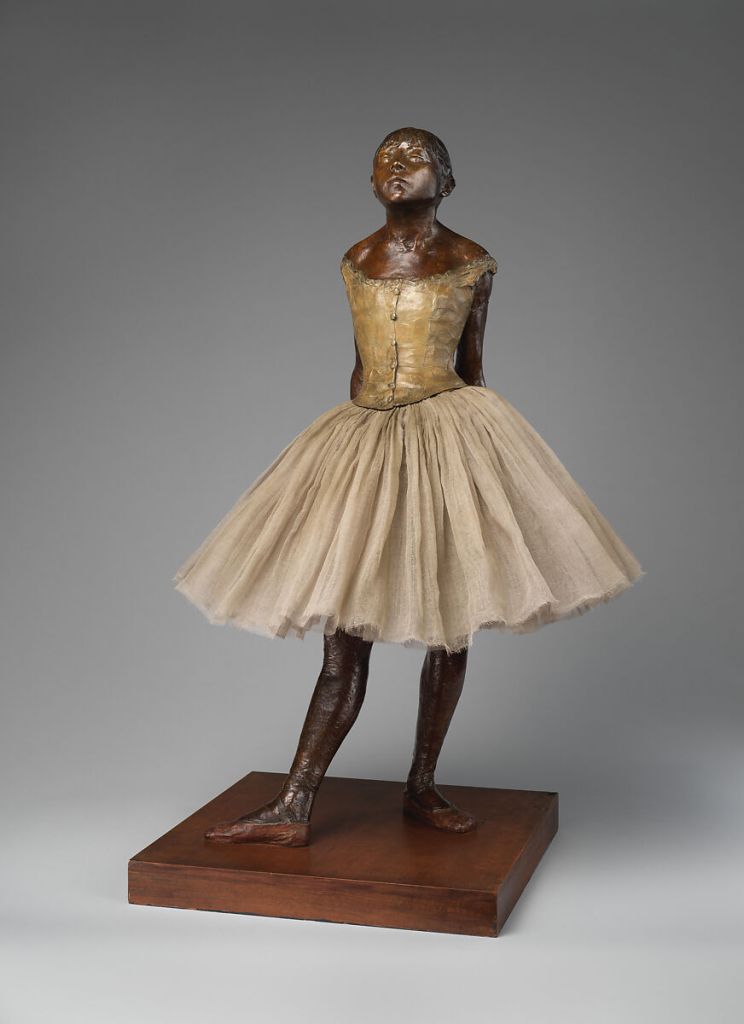
Edgar Degas, a French Impressionist painter and contemporary of Diaghilev and the Ballet Russe, famously used the ballerinas as inspiration. His sculpture of the ballerina, one of the most well-known works on view at the Met is the bronze cast called “The Little 14-year Old Dancer.” Not much is known about her besides that she was from a very poor family and was used by Degas without much benefit to her in the form of respect or compensation.
The story of American ballet was started by Lincoln Kirstein with collaboration from George Balanchine (Born Georgy Balanchinadze in the Georgian Republic of the Soviet Union). Balanchine choreographed over 140 ballets during his life. His legacy lives on in the American School of Ballet that he helped established with Lincoln Kirstein and Jerome Robbins.
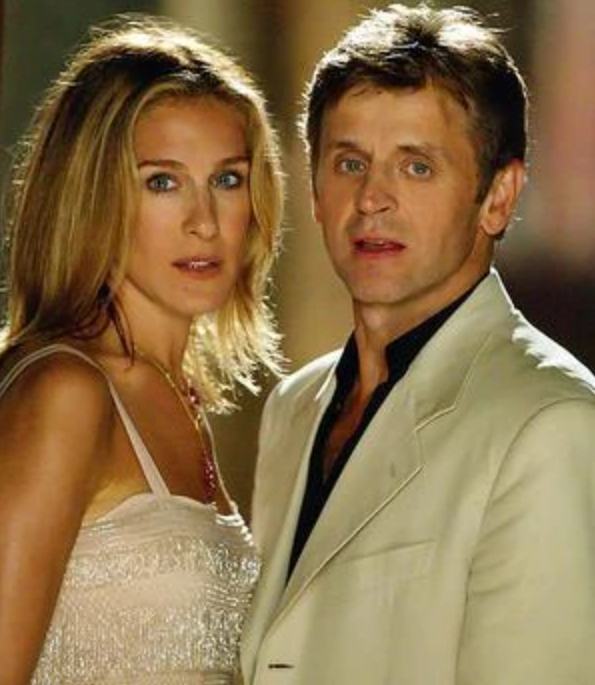
Now principal ballerinas are famous, many have risen to celebrity heights, many have become legendary, making a leap to other mediums, such as the Hollywood big screen. Remember the show “Sex and the City” and Carrie’s “Russian.” In the show he was called Alexandr Petrovsky, but in real life he’s a famous ballet dancer (danseur) Mikhail Baryshnikov.
The most magical thing about ballet is its beauty and elegance. You don’t have to know the movements, the positions or the names of the jumps. All it takes is an open mind to appreciate the language it speaks, the way a body can move to create emotions that are powerful and evocative. It can move the audience in a way words never could. I find myself holding my breath at times, completely overtaken by the geometry the dancers create with their bodies. The fluidity of the movements, the lines and angles. Whether classical, American or modern, ballet is an unbelievably beautiful art form that’s accessible to anyone.

Leave a Reply