

Met lovers have their favorite pieces and their most cherished galleries. My friend, Dora, the brilliant designer and creator of this blog, has a favorite in the European Sculpture and Decorative Arts wing. Her name is Musette and it’s a dog, a gorgeous Maltese.
“Every time I go to the met, says Dora, whether by myself or with out of town visitors, I start with Musette. Hello Musette, I say, hello dear friend.”


Its my first time visiting Musette so I’m following the museum’s interactive map to make my way to her. It’s not crowded today so I use the main entrance, go up the famous Met steps into the huge, impressive entrance hall, fittingly called the Great Hall. The information desk is in the middle so you can always ask for directions, if the map is not your thing. I continue straight ahead, passing Byzantine art to the Medieval Arts. It’s an enormous, cavernous space with 100 ft ceilings that’s supposed to feel like being in a medieval gothic cathedral. From medieval times, I make a left to the Sculpture Hall. It connects the original Met building to the extensions built west into Central Park, and I can see the Moorish Arches of the original building in red brick, juxtaposed with the light limestone of the extension. Connecting the two is a vaulted glass ceiling. Right in front of me rises the sculpture of the mighty warrior Perseus, holding the head of Medusa. You can’t miss it, its placed in the middle of the walkway in the Sculpture Hall. Bathed in light, it’s ever so impressive. Medusa has snakes coming out of her head. Don’t look directly at her, she has the power to turn anyone into stone. Perseus defeated her by not looking at her directly but at her reflection in his shield.
Continue straight ahead and once you reach the elevators, make a left into gallery 556. Our furry muse is behind the glass on the right hand side of the gallery. Look at the interactive map for directions on how to get there or ask the security guards stationed in each gallery:
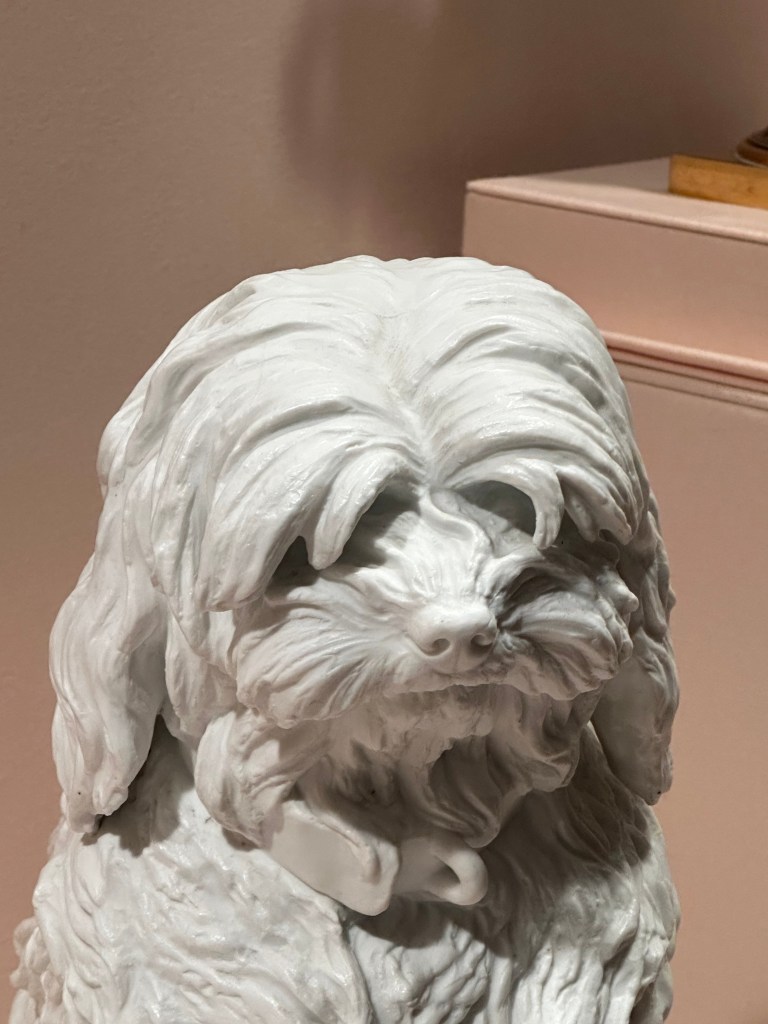
“Hello Musette”, Dora says every time she sees her. She loves her and it seems mutual. Musette is always there, so sweet and cuddly, ready to play, ready to be petted. I’m glad this sculpture is behind glass, it would be too tempting not to touch her, especially for kids. What a lovely creature, she seems alive and moving, her feet positioned for action and her collar sticking out, ready to be clipped to a leash and taken for a walk. The white hair is covering her eyes and it looks wavy and soft. Her nose is also white, which makes her face look even softer, almost angelic.
I thought this statue was made out of marble but its actually made out of material called Parian Ware, which is a type of porcelain developed to look like marble. So in reality, its much lighter than it looks, and its also fragile, breakable like a dish. Again, great idea to put her under glass display.
Parian Ware takes its name from the Greek island of Paros, where the famous Parian Marble is mined. Borrowing the name is great to enhance the appeal, its porcelain that looks like marble and has the name of the famous Greek marble. Nicely done!
The sculptor that made this sculpture is Jean-Baptiste Gille, but it was not an original idea, it was based on the sculpture by Albert Ernest Carrier-Belleuse, who was a talented and versatile sculptor, working across a number of materials and styles in the second half of the 19th Century. In fact, because the sculpture is not dated, its given a wide range, possibly created between 1855 and 1868. Albert is perhaps most famously known for his apprentice, Augustine Rodin. Arguably the most famous sculptor in history, Rodin has immortalized historical moments, human emotions and famous figures, including a powerhouse of French literature, Honore de Balzac. The sculpture can be see at the Met along with many other examples of Rodin’s wide oeuvre.

Final Study for the Monument to Balzac by Auguste Rodin

Getting back to our little doggie, what a cutie. Maltese is such a beautiful breed, the American Kennel Club believes it’s dated to classical antiquity with ancient Roman patricians (wealthy aristocratic ladies) having these breed as their lap dogs. I can believe it, they are so cute, so perfectly white and have this beautiful hair that grows really quickly. They look amazing when trimmed, regal when brushed out for doggie shows, and really fluffy if the hair is left to grow a bit but not too long, as on our Musette.

I’ve finally made my way through the museum and found this beautiful sculpture. I’m so glad I did. It’s soo lifelike, you’d think it would be soft to the touch. Her stance is upright and proud, she’s standing on a rectangular pedestal, her little tale is hanging off the back of it, making it somehow more realistic and less staged. Her name, Musette, is prominently displayed in large block letters on the front. Perhaps derived from the word “Muse” which refers to Greek and Roman mythology, Muses were 9 goddesses and daughters of Zeus (head honcho) that presided over arts and sciences. In more modern application, muse is someone who inspires creativity, like artists’ models that breathed new innovative energies into their work.
I wonder what Musette’s story is and how come she came to be immortalized in history, who was her owner, did they commission this work? Did the sculptor know this dog, did he love her?
I’ve had two dogs in my life and they both have been Malteses. They were completely opposite personalities but both enjoy my company, love attention and are really, truly, sweet creatures. Both love treats and live for them, neither of them would run after a toy, only a tasty morsel would get them to move.


When my first baby passed away, I was devastated, we were so attached, she was always with me. I had a local artist paint a little portrait of her based on her picture to remember her forever. I wonder if this dog was so loved, the sculpture was commissioned en memoriam, to immortalize her in posterity. It was successful, Musette is still with us and is still very much loved.
Leave a Reply