

17th Century Northern Europe in NYC
Dutch masters at the Met – a glimpse into the world so far away from our own, and yet so relatable. There’re families and people laughing, and the wealthy just want to be entertained.
Walking around these galleries, tucked away in the back of the Met in the Robert Lehman Wing, gives me a fresh new take on the works of art created over 400 years ago. Rembrandt is here, of course, as well as Vermeer, Frans Hals, and Jan Steen, to name a few.
When I think of Dutch painting, dark and gloomy portraits come to mind with serious looking white men in white frilly collars. The collars always intrigued me, painted so elaborately and skillfully. There’re also religious paintings, masterfully done, but how many baby Jesuses can you stomach in one sitting. Although there’re some truly exciting depictions of hell to keep people in line (will need a separate post on that), overall this period didn’t make my heart smile. Until today…
Reality TV
Many of these paintings were commissioned by wealthy patrons, and display comic and even vulgar scenes. There’re dogs copulating, people drinking, and smoking, all signs of debauchery with loosened corsets, and reddened cheeks. Wine is flowing and there’s meat aplenty. This was not reality. This was pure fantasy made up by the artists to entertain the viewer. Imagine the time before TV, radio, and smartphones. The only entertainment was live. You went to see shows, live theatre and music, the uber wealthy had the entertainers come to them. The only stationary amusements were these works of art. They were 17th Century Reality TV series, meant to take your mind off your day-to-day, much as modern-day reality TV. They depict silly people doing silly things, and its wildly entertaining, even includes cross dressing. Who knew Dutch Golden Age painting could be so quirky and fun?
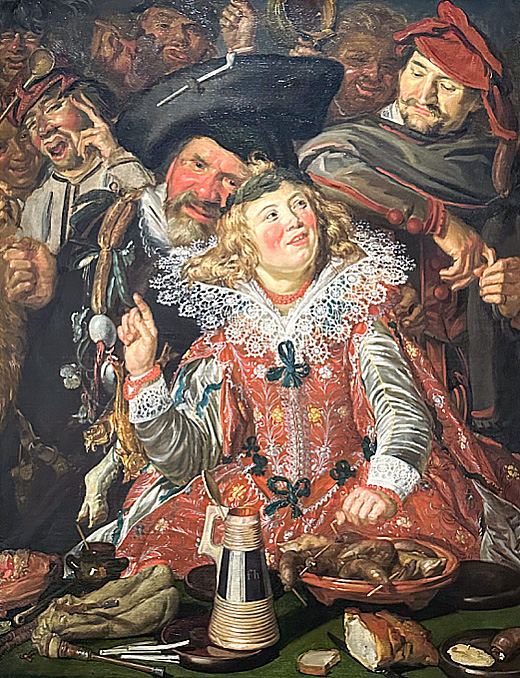
Frans Hals 1616-1617 “Merrymakers at Shrovetide”
FUN FACT: Did you know the original word for Mardi Gras is Shrovetide? WHAT?!? I didn’t make it up, promise. Shrovetide came from Shrove Tuesday also called Fat Tuesday. It was the period right before Lent when all the food had to be eaten to prepare for the fasting of Lent.
This painting by Frans Hals called the Merrymakers of Shrovetide depicts Mardi Gras. This is the origins of the tradition that could be observed as music and carnival in New Orleans. In Netherlands, it was the festive period before Lent, where theatre troops would dress up and put on ridiculous skits, full of sexual innuendos. The girl in the middle of the painting is actually a boy. Men would dress up as a women, wear wigs, make up, dresses, and jewelry. Women were not allowed to participate in these types of performances. It’s full of sexual symbols everywhere you look. The character on the right is wearing a sausage on his hat, while making lewd gestures with his fingers. The character on the left, ruddy-faced and happy, is wearing a sausage and egg vine around his neck with his arm around the boy, who’s playing a girl. There’re bursting sausages and deflated bagpipes on the table. These colorful characters remind me of carnival, a jumble of faces, drinking, and partying.
FUN FACT: NYC historic area of Harlem comes from the town of Haarlem, Netherlandsֶ, the birthplace of the artist mentioned above, Frans Hals. When the Dutch settled here and called the city New Amsterdam, this area was initially called “Nieue Haarlem,” New Harlem. We’re also aligned on the timeline as this painting was done around the same time this area was settled in the 17th Century. When the British took over the colony, they renamed New Amsterdam to the name we all know today, New York. Nieue Haarlem was shortened, but not changed, and became the Harlem we know today.
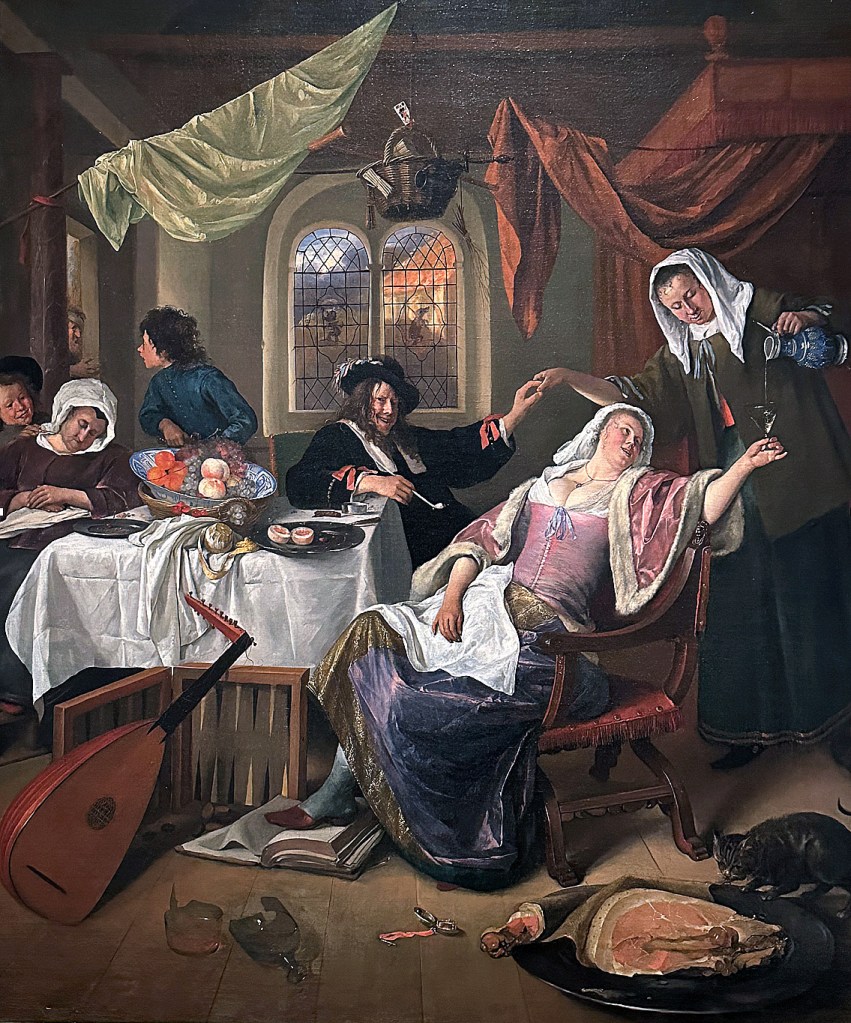
Jan Steen “The Dissolute household”
Dutch golden age painting 1663
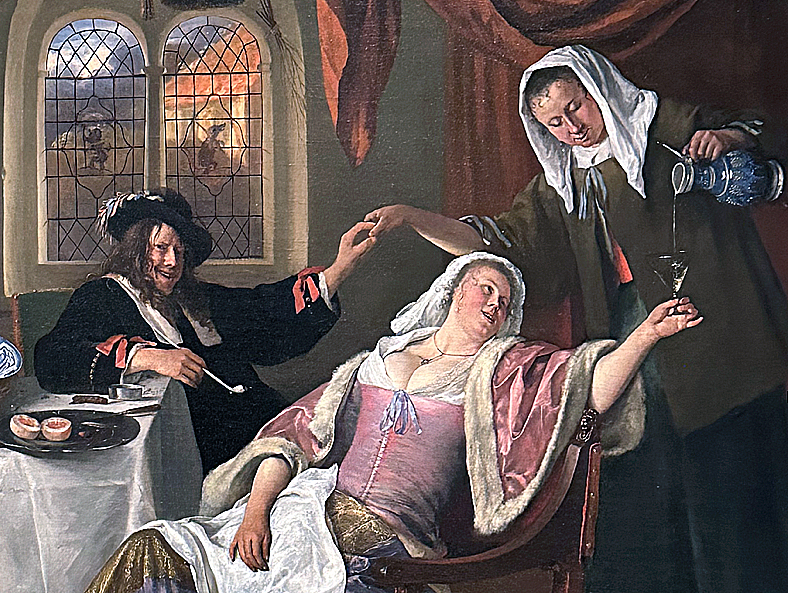
Jan Steen “The Dissolute Household” 1663
This one in particular is an interesting example with the artist placing himself in the middle of this disturbing, drunk family. He is holding hands in an overtly sexual gesture with the maid, as she’s pouring a generous drink for his wife. The artist’s other hand is holding a long pipe, I’m guessing opium. The red fabric, as well as the basket above their heads, are all bad omens, crowned by a jack of spade, which signified misfortune.
I wonder what his wife thought of this work when she saw it. I’m not sure I’d want to be in her shoes….
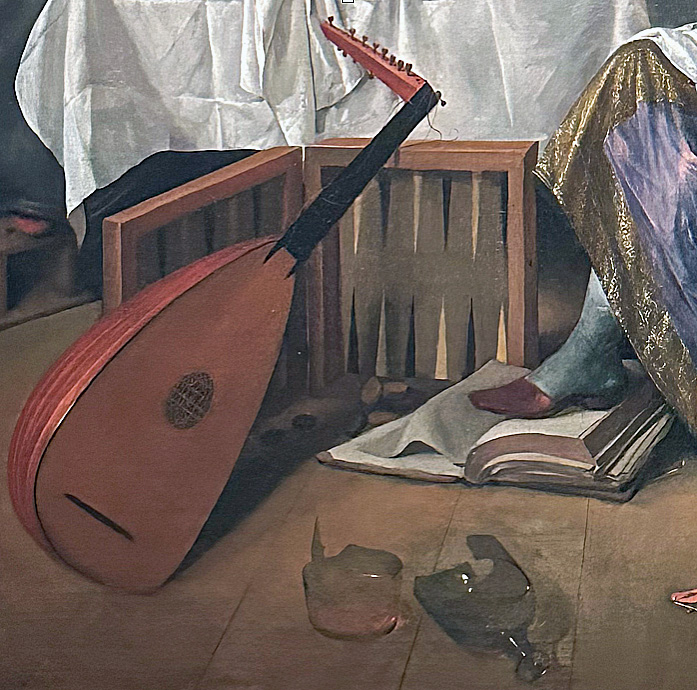
Speaking of her shoes, her foot is clothed in a cute brown mule, which appears surprisingly modern. But the rest of he scene is quite disturbing and no one here come off well. The wife is drunk, and has her foot on a book, next to a broken bottle; expressing her disdain for knowledge and education. There’s a musical instrument on the floor, with broken strings. It’s called lute, and is played like a guitar. Lute is a very ancient instrument found in Egyptian and Greek art, and popular at this time in the 17th Century. There’s a backgammon board laying on the floor. If you have a backgammon app on your phone, you’re continuing this ancient tradition 😆
Leave a Reply