
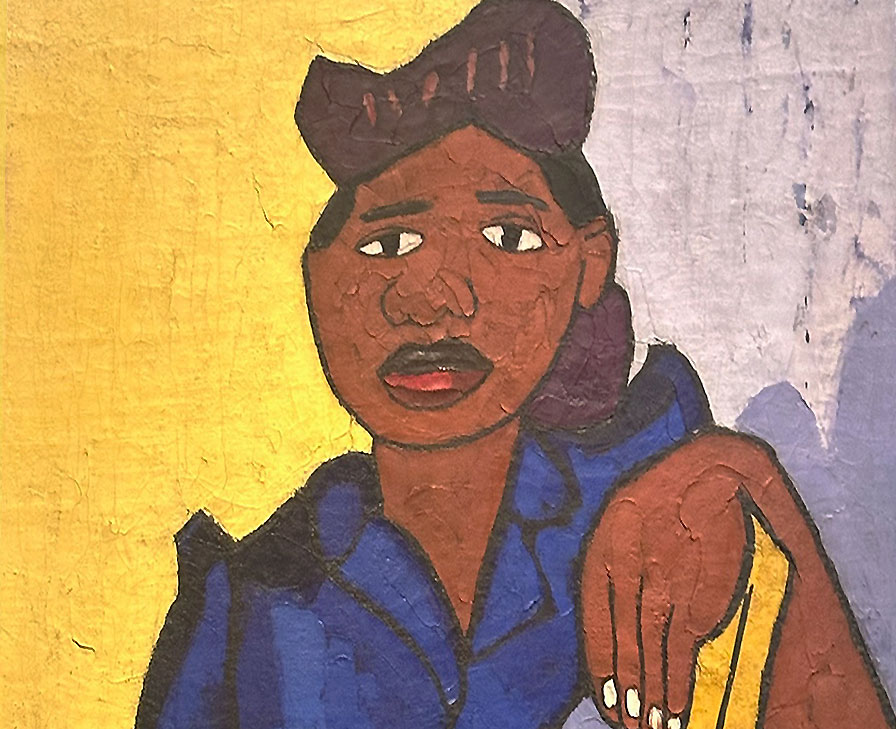
Go see this exhibit to experience the joy of new discoveries for yourself. It’s on view through July 28th at the Met Gallery 999, check this map for easy navigation. I’m absolutely blown away by its scale, depth, diversity of artists, mediums and expressions. This movement cannot be covered in a short blog post. It’s vibrancy translates across mediums, from literature to painting, sculpture, performance arts, movies and music and doesn’t lend itself to a singular definition. It’s a celebration of artists of color from different origins and seeks to find new, creative ways of self-expression and of being in a world that is largely not accepting of them.
Watch this incredible video by the curator of the exhibition, Denise Murrell. She eloquently describes this groundbreaking movement of black artists that began as an explosion of creativity across American cities, such as NYC and Chicago and the global diaspora of artists working in Paris and other places.
It sets the stage for us to travel back in time to the 1920s – Jazz Age, changing social norms and fashion, flappers, dance halls, massive migration of African Americans from rural segregated south under Jim Crow to the industrial cities to establish a new life, to start over. It’s a heartbreaking but important part of our history that is memorialized in the work of these incredibly talented and brave artists who seek to find themselves and new ways of being in new places, away from their roots, away from their past, but still very much defined by racism and limited in their opportunities.
In my lexicon, I would compare it to the modern art movements that sprung up in Paris at the end of the 19th and beginning of the 20th Century, with artists going against conventional, academic discipline to create something individual, emotional, that breaks with the past and informs the future. It’s an artistic, bohemian, cultural diasporas where artists mingled, collaborated and partied with musicians, dancers, sculptors and writers in Parisian cafes, and salons; where people flogged to from all over the world to find means of self-expression and to rebel against rigid norms.
Harlem Renaissance exhibit is groundbreaking in its celebration of this incredible movement that, by and large, is missing from art history textbooks and requires a closer examination by all of us. To know our past is to understand our present. Works of art by Black artists living in the US and Europe, explorations of ways of being in a world that doesn’t accept you, with institutionalized racism, it challenges many of the accepted paradigms and provides fertile ground for discussions and further discoveries. Works by Aaron Douglas, Winold Reiss, William H. Johnson, Hale Woodruff and Jacob Lawrence deserve their place in our most prominent museum collections, alongside Vincent Van Gogh, Claude Monet, Henri Matisse and Pablo Picasso.
Below is the work of Aaron Douglas who painted the beautiful Ms. Zora Neal Hurston. She was an incredible woman, a writer, anthropologist, filmmaker, singer. She was fearless, well-rounded, and extremely talented, not afraid to break through the expected norms and to publish amazing books, such as “Their Eyes Were Watching God,” which is presented alongside her portrait. This portrait is intimate and moving, the artist, Aaron Douglas, knew Ms Hurston and admired her. They were part of the Harlem Renaissance movement and took part in lively debates on art and culture in cafes and living rooms. She is depicted as independent, intelligent and well-dressed in a beautiful red coat even though she died in obscurity and poverty. Her work was revived posthumously, like so many exceptional contributors to culture:
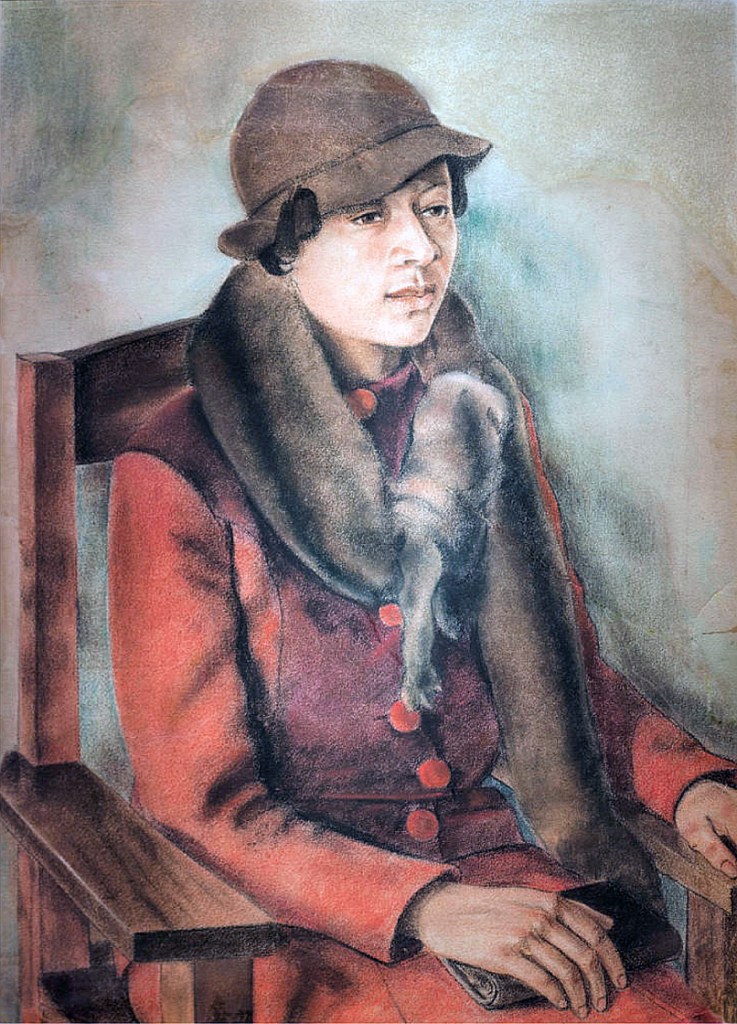
by Aaron Douglas
This work is a drawing on illustration board by Winold Reiss of one of the key people in the Harlem Renaissance movement, Alain Leroy Locke. It traveled to the Met from the National Portrait Gallery, in Washington DC and was painted in the same year as the portrait aboveֶ 1926. The treatment of this figure is quite different, its focus is the face and the hand, with the body sketched in. The details of the face and the hand are so vivid, realistic and alive, it’s hard to believe this is a drawing. Mr. Locke is depicted as thoughtful and pensive, but also pained, with the weight of injustice on his shoulders. He was one of the founders of this movement and his seminal work, “The New Negro” is displayed alongside his portrait. He was distinguished as the first African American Rhodes Scholar in 1907 and was known as the “dean” of the movement, extolling the roots, talent and contributions of black artists and the contribution of black diaspora to the global cultural experience.
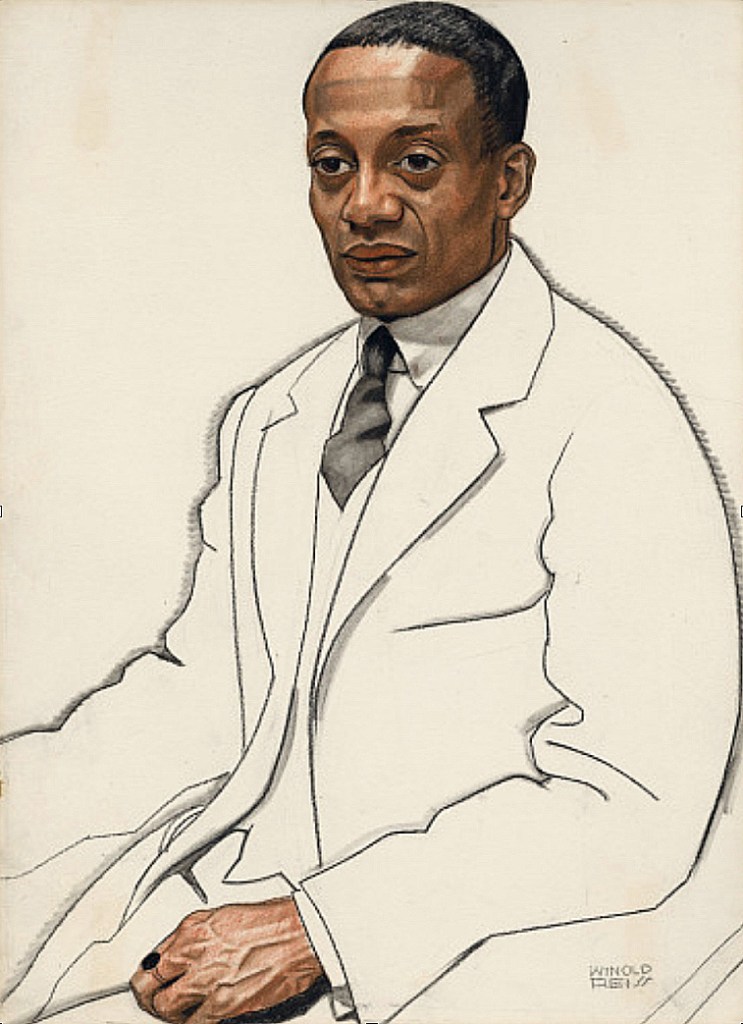
by Winold Reiss
In fact, Harlem Renaissance is a misnomer since the movement was truly global, in every sense, from where the artists were born to where they worked. It took place across large cities from NY, Philadelphia, Chicago, LA, among others, as well as European cities, particularly Paris. The artists worked and sometimes lived together, sharing influences and inspiration, collaborating across mediums, looking to the new modern art movements emerging in Europe, the visual arts across the African continent, such as sculpture, pottery, textile and masks. They created momentous, unique and moving works of art.
My favorite artist in the show is William H. Johnson. Born in Florence, South Carolina, he was incredibly gifted and moved to NYC to complete an academic art education at the National Academy of Design. Whilst a student at the Academy, his talent shone so brightly, one of his professors helped to raise money that gave him the freedom to move and travel across Europe and to be able to see the work of the modern art movements exploring different ways of approaching art. Johnson took his academic education, coupled with his exposure to various art movements and came back to the US to create work that was a strong, colorful and unforgettable statement of Black American culture.
Woman in Blue displayed below reminds me of the colors and rough brushstrokes of Henri Matisse, purposefully getting away from realistic representations and exaggerating certain elements, like the hands. It also has a diagonal composition with the woman placed at the center while the yellow background on the left echoes the chair on the right, the blue background on the right plays off the blue dress. It’s bright, dynamic and visually stunning.
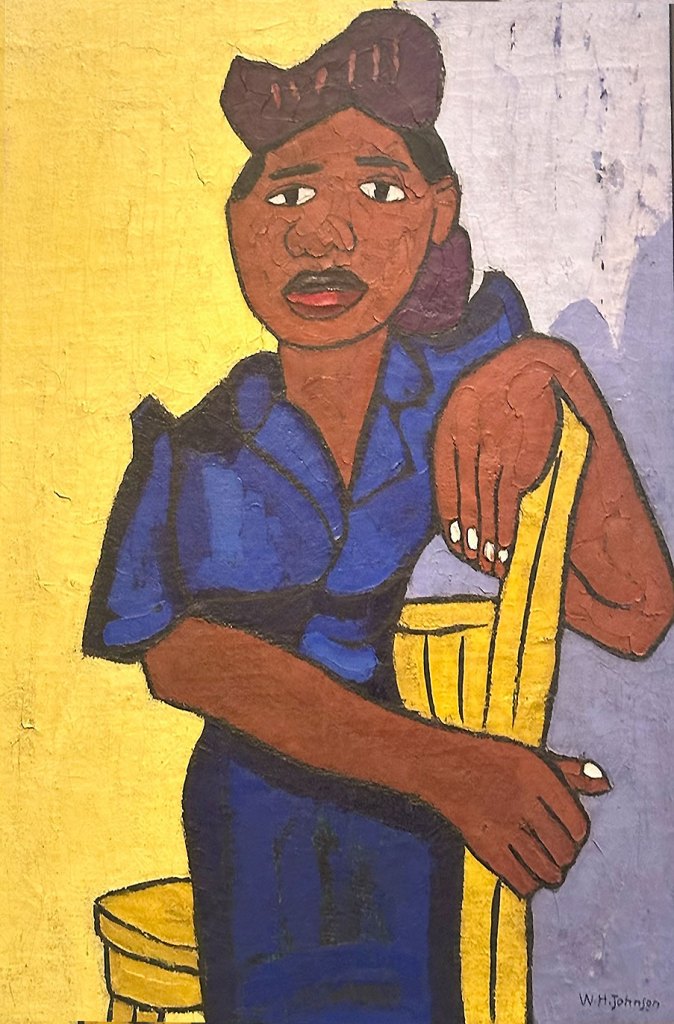
Woman in Blue
William Henry Johnson
ca 1943
Oil on burlap
Clark Atlanta University Art Museum, Georgia
Another Johnson masterpiece is the Flowers | Smithsonian American Art Museum (si.edu). This painting is supremely beautiful. It’s colors are strong and powerful, it’s brushstrokes reminiscent of Van Gogh with layers of paint piled up to create a visually engaging experience, making it harder to walk away. The background is a monolithic color that allows the focus to be drawn to the flowers, not as objects, but as something that is alive, and ever-changing.
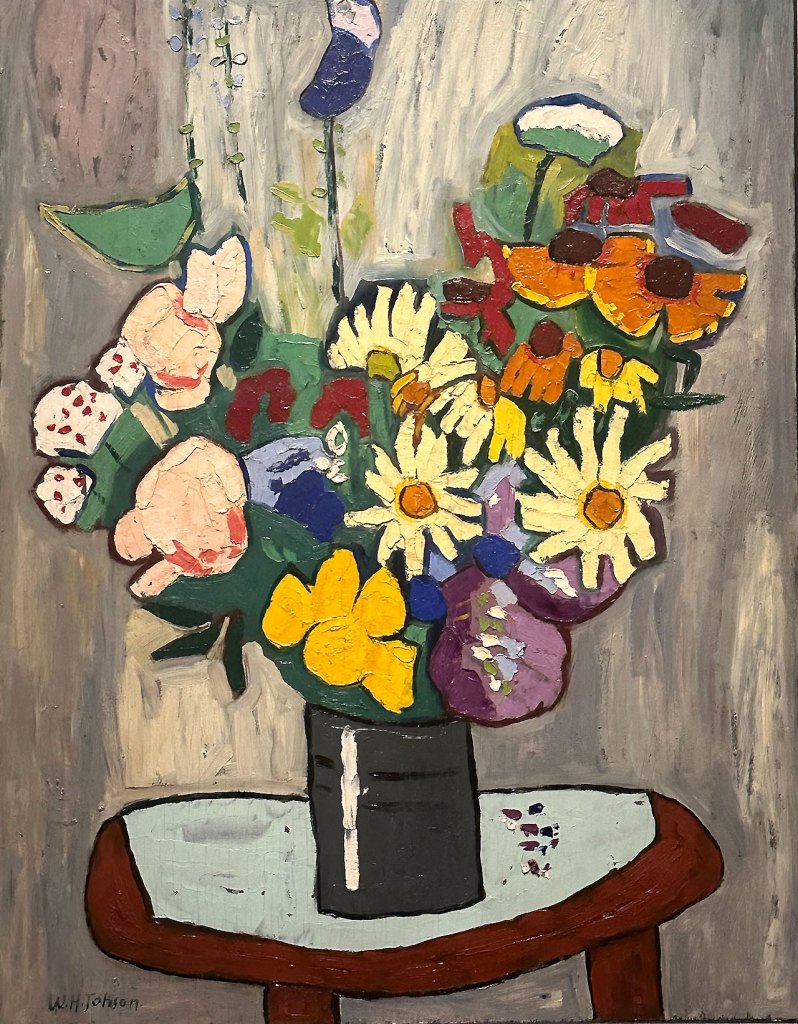
FLOWERS William Henry Johnson
1939-1940
Oil on plywood Smithsonian American Art Museum Washington, DC
Man in a Vest, painted the same year as the Flowers, reinforces the painter’s unique style, making it easy to recognize this as a work by Johnson. The treatment of the hands, the composition, the red chair contrasting with the yellow background, it’s makes for a compelling, interesting and unforgettable portrait.
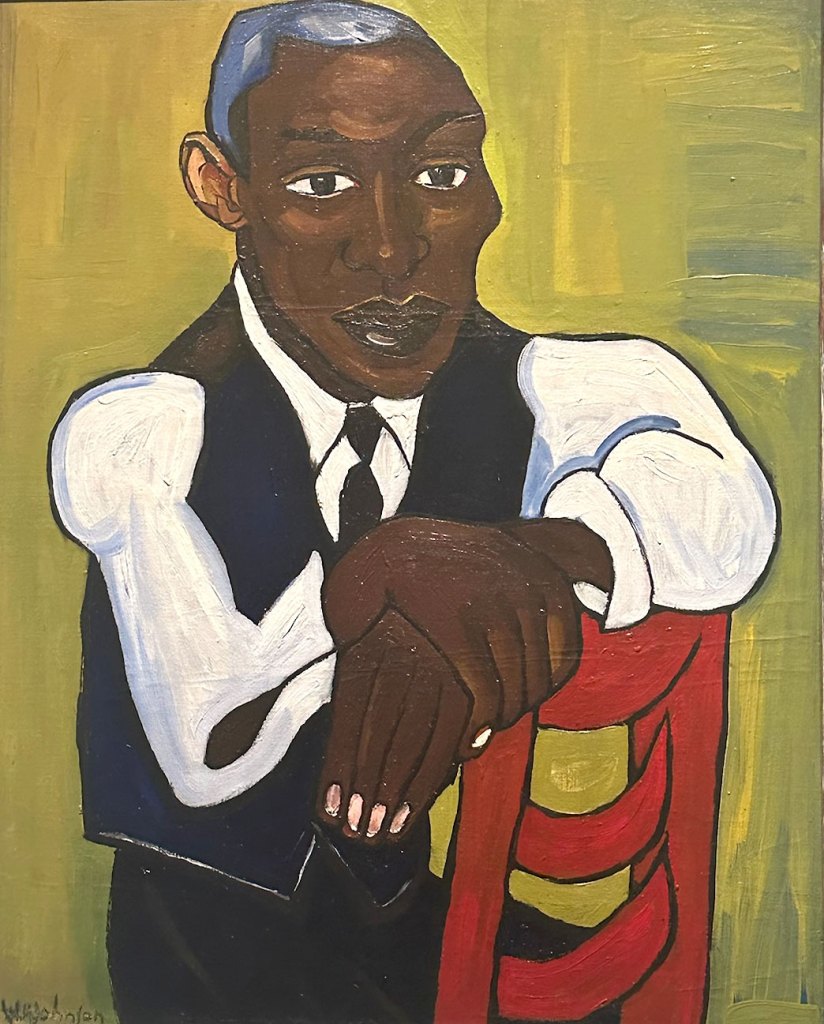
Man in a Vest
William Henry Johnson 1939-40 Oil on Canvas
Smithsonian American Art Museum, Washington, D.C.
Street life, Harlem by Johnson is an absolute masterpiece. It’s so bright, colorful and happy. The stylish couple are ready for the night on the town, the bright red gloves and white pumps on the woman are complemented by the light jacket and a feathered hat of her male companion. The buildings in the background are just as bright with pinks and blues, the moon is deep orange and the fire hydrant is rose pink. It all comes together to create a picture of Harlem style, capturing a moment where people dress up to enjoy themselves after a long week, probably going out to eat, may be a night club with dancing. It’s hard to believe his work didn’t receive the recognition during his life, he died penniless in a state mental hospital and only through the foresight of his friends, did his work survive and is now gaining well-deserved prominence and recognition.

Street Life, Harlem William Henry Johnson 1939 – 40Oil on PlywoodSmithsonian American Art Museum, Washington, D.C.
Another masterpiece from this show influenced by modern art movements is the Card Players by Hale Woodruff. Just like Johnson, Woodruff had an opportunity to live in Paris and to experience modern art movements firsthand. In this work, influence of cubism (Pablo Picasso and George Braque) is apparent in the geometrical composition and dissection of the faces and bodies, while the color technique is influenced by post-impressionists, such as Paul Cezanne. This painting reflects on his understanding of various modern art movements and combines it with his own interpretation, adding in West African traditions and Baule masks particularly noticeable in the elongated face features.

Hale woodruff
American, 1900 – 1980
the card players, 1930
Oil on Canvas
The Metropolitan Museum of Art, New York
To end on a hopeful note, let’s take a quick look at the Pool Parlor by Jacob Armstead Lawrence. Lawrence was one of the most recognized African American artists during his life and the Pool Parlor was the first work of art of its kind purchased by the Met into its permanent collection in 1942. It depicts one of the many pool halls on Lenox Avenue at that time, with the dark atmosphere, punctured by pool cues and zigzagging cigarette smoke. It’s a celebration of African Americans in Harlem, the community, the pass times, presented by an African American artist who grew up with financial struggles but was recognized for his artistic talent quite early on with the first show at the age of 18. Some biographical highlights can be seen in this video.
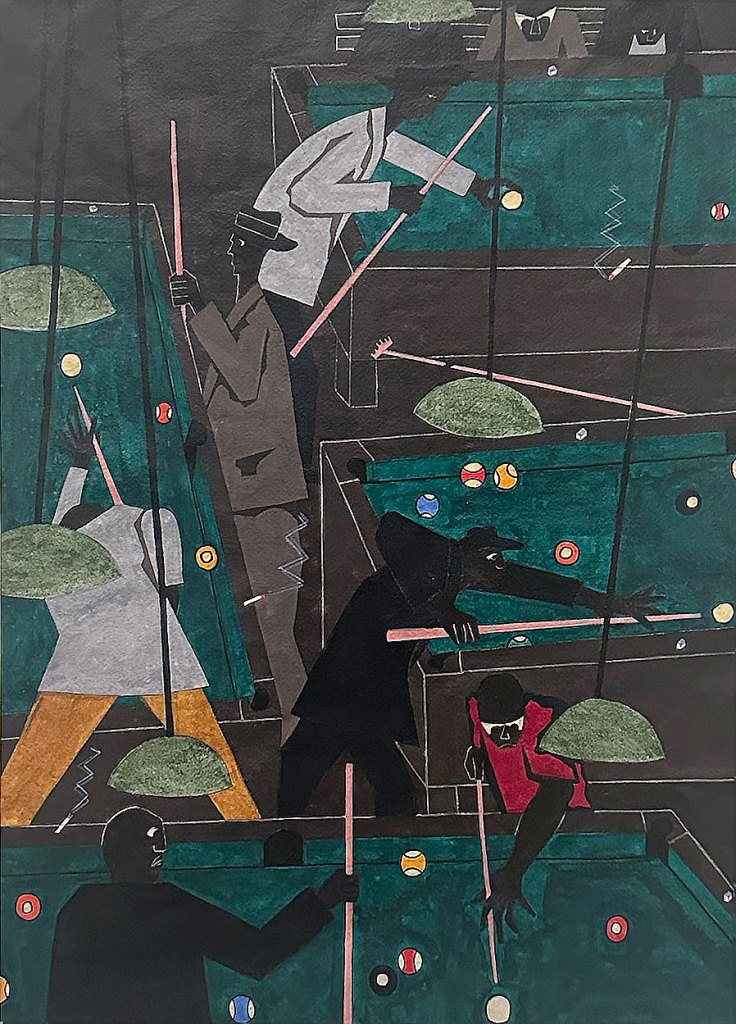
Jacob Lawrence
American, 1917 – 2000
Pool Parlor, 1942
Watercolor and Gouache on Paper
The Metropolitan Museum of Art, New York
There’s so much more to see in this show and so many incredible artists that have been omitted here. Will try to get back to the exhibit and create more blog posts but in the meantime, the Met is looking for new ways to expand its audiences and to engage with the art exhibits in interactive ways. There’s also a podcast series to accompany this groundbreaking and long overdue exhibit that could be played on apple or any apps you use to listen to podcasts.
Leave a Reply